
If you’ve been told to rest your patellar tendon pain, you’ve been given advice that sounds logical but is often completely wrong for this type of injury. Rest reduces the pain. But it doesn’t fix the tendon. And it doesn’t fix the reason WHY the tendon started hurting in the first place. In fact, it often makes the “root cause” issue worse. After rest, people often notice the moment they go back to the activity that caused it, the pain comes right back. Often starting faster and hurting worse.
Tendons don’t heal with rest
Tendons adapt and strengthen in response to load, and they weaken and degenerate without it. When a tendon has been chronically overloaded, the fix isn’t removing all load. It’s finding the right amount of load and progressing it correctly. This is why the boom-bust cycle of rest, feel better, return to activity, feel worse is so common with patellar tendinopathy.
Think of it like this- the tendon is hurting because it’s weak (has a low load tolerance). Resting, or do nothing, makes it weaker. Thus, more susceptible to pain and injury.
So, what do we do? I’ll describe below but the basics are: we need to “strengthen the tendon.” The technical term for this is, “increasing the tendon’s load tolerance.”
The three stage loading approach
Stage one is isometric loading. Hold a wall sit or Spanish squat for 30 to 45 seconds. Isometrics provide an analgesic effect, reducing pain in the tendon for up to 45 minutes after the exercise. Stage two is heavy slow resistance. Slow squats, split squats, step downs, at a 3-second down, pause, 3-second up tempo. This is where real tendon adaptation happens. Stage three is energy storage loading: plyometrics and sport-specific movements that prepare the tendon for the actual demands of activity.
Remember: the more painful it is, the slower you need to move while strengthening it. The slowest you can move is to not move at all (isometrics). For very painful tendons, this is usually where you need to start, then build from there.
Where StemWave fits in
For tendons that have been stuck for a while, the body stops sending healing resources to chronically irritated tendon tissue. StemWave focused shockwave therapy delivers focused acoustic waves that trigger a cellular level response: shifting macrophages from pro-inflammatory to anti-inflammatory, stimulating angiogenesis, and recruiting mesenchymal stem cells. Essentially it restarts the healing process in tissue that had stalled.
We combine StemWave with the progressive loading program. The combination produces significantly better outcomes than either approach alone.
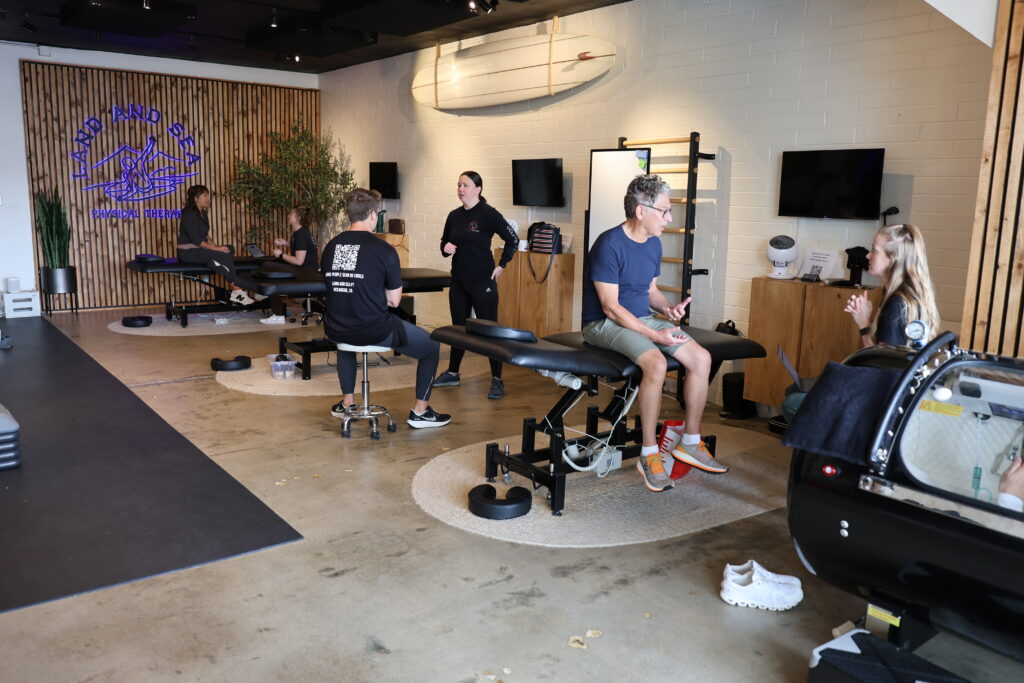
At Land and Sea PT in Oceanside, we see patients 1-on-1 with a Doctor of PT every session. If you’ve been stuck in the rest-and-return cycle with knee tendon pain, we can help you get out of it.
If you want to contact us or book an appointment, check our business profile page.

Dr. Jonny Blue is a Doctor of Physical Therapy and founder of Land and Sea Physical Therapy in Oceanside, CA. He specializes in orthopedic PT, root cause methodology, and helping active adults in North County San Diego get back to the activities they love without surgery or pain medication.