Shoulder pain during an overhead press almost never starts where you think it does. Most people focus on the ache in the front of their shoulder, foam roll the rotator cuff, and call it a day. But if that approach keeps failing you, the real issue may be your scapula (shoulder blade), specifically how it moves when your arm goes overhead. This is one of the most consistent patterns we see with shoulder pain during overhead pressing, and once you understand how the shoulder blade is supposed to move, the rest starts to make sense.
Your Shoulder Blade Has to Move With Your Arm
When you lift your arm overhead, your shoulder joint and shoulder blade are supposed to move together in a coordinated sequence called scapulohumeral rhythm. Think of it as a two-part handshake: your upper arm bone rotates in the socket while your shoulder blade simultaneously rotates upward along your ribcage. This coordinated movement helps create space in the shoulder so the surrounding tissues aren’t repeatedly compressed.
The muscle that plays a major role in driving this upward rotation is the serratus anterior. Most lifters have never trained it deliberately, and many don’t even know what it does. The serratus wraps around your ribcage and attaches to the inside border of your shoulder blade, helping pull the blade up and around your ribs as your arm moves overhead. When the serratus isn’t doing its job effectively, the shoulder blade can lag behind, leaving the upper arm with less room to move efficiently.
The Four Muscles That Control Scapular Position
Seventeen muscles influence where your shoulder blade sits, but four play a particularly important role in what some practitioners call the scapular X. On one diagonal, you have the pec minor in the front and the lower trapezius in the back. On the other, you have the rhomboids, which attach to the inside edge of the shoulder blade and pull it toward the spine, and the serratus anterior, which helps counterbalance that pull by rotating the shoulder blade outward and upward.
When these muscles work together effectively, your shoulder blades stay connected to your ribcage and move smoothly as your arm moves. When they’re out of balance, which is common in people who do a lot of pressing, the shoulder blade can begin to tip forward or pull excessively toward the spine. For many powerlifters and bodybuilders, years of heavy pressing can contribute to a stiff pec minor and an underused lower trap. The result is a shoulder blade that tips forward or hangs away from the ribcage instead of staying well-positioned against it.
How to Tell If Your Scapula Is the Issue
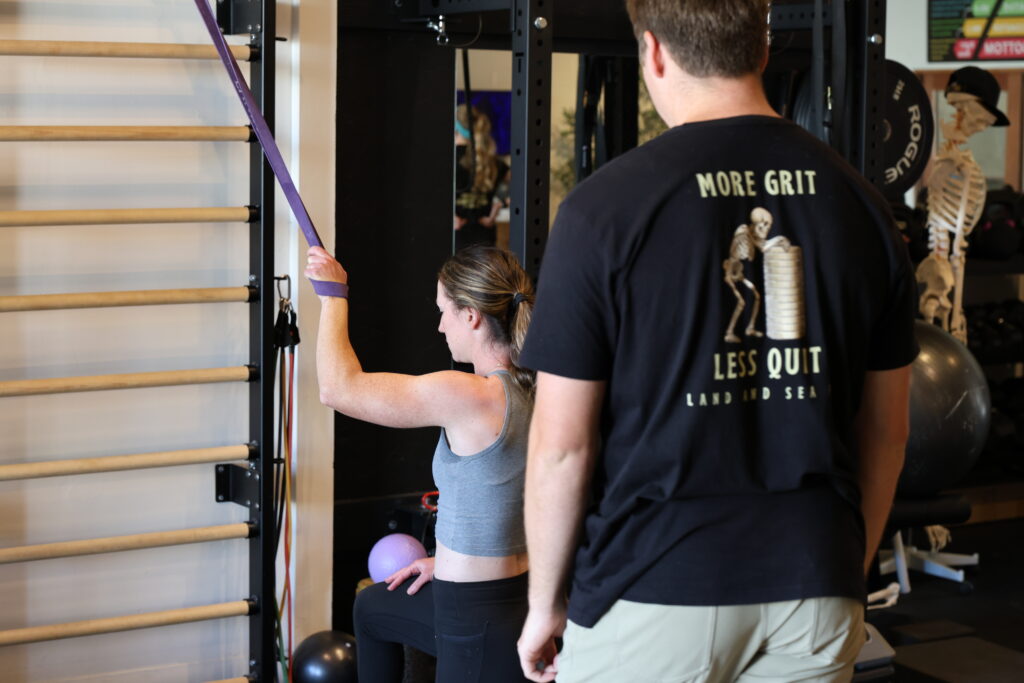
One simple way to screen your shoulder blade movement is to raise one arm overhead while watching yourself in a mirror or having a training partner watch from behind. Ideally, the shoulder blade should rotate upward smoothly as your arm rises. If you notice excessive shrugging, the shoulder blade pulling toward the spine before rotating upward, or the inside border of the shoulder blade lifting away from the ribcage, your scapular mechanics may need attention.
You can also look at the resting position of your shoulder blades. The inside border should sit relatively close to the spine, and the shoulder blade should have a slight upward tilt. If the shoulder blade sits excessively close to the spine or appears to tilt downward, it may indicate that certain muscles are pulling it out of position before you even start moving. Keep in mind that a self-screen can’t diagnose the cause of your shoulder pain, but it can help identify movement patterns that may be worth having a professional assess.
Why This Matters More Than Stretching the Shoulder Itself
Stretching your pecs, opening your chest, and improving shoulder mobility can all be helpful, but they aren’t always enough if the underlying movement pattern is still off. The shoulder blade needs to be actively controlled, not just passively positioned. That’s why treatment for shoulder pain during overhead pressing should often include motor-control exercises for the serratus anterior, along with appropriate strengthening and mobility work.
Exercises like serratus wall slides, quadruped serratus reaches, and bottoms-up kettlebell carries can help teach the shoulder blade to move and stabilize more effectively. The goal isn’t simply to make the shoulder blade stronger. It’s to improve how the shoulder blade moves and coordinates with the rest of the shoulder when you’re actually using your arm.
Why the Landmine Press Is So Useful
The landmine press is one of the best loaded exercises for putting these concepts together. Because the bar travels at an angle rather than directly overhead, it allows you to train the pressing movement while placing less demand on the shoulder’s end-range overhead position. As you press, the movement encourages the shoulder blade to rotate upward and move naturally around the ribcage.
Adding controlled torso rotation at the top can further challenge the serratus and reinforce that movement pattern. For someone returning to overhead pressing after dealing with shoulder pain, the landmine press can be a useful stepping stone while you work on the underlying strength and movement deficits.
The Takeaway
If your shoulder hurts when you press overhead, don’t automatically assume the problem is inside the shoulder joint. Look at the shoulder blade. Your scapula needs to move well, stay connected to your ribcage, and remain controlled under load. That movement is the foundation for everything happening at the shoulder.
Rotator cuff strengthening, mobility work, and gradual loading all have their place, but if your shoulder blade isn’t doing its job, those strategies may only get you so far. If you’ve been chasing shoulder pain during overhead pressing without looking at the scapula, it may be time to change your approach.
If you want to contact us or book an appointment, check our business profile page.

Dr. Jonny Blue is a Doctor of Physical Therapy and founder of Land and Sea Physical Therapy in Oceanside, CA. He specializes in orthopedic PT, root cause methodology, and helping active adults in North County San Diego get back to the activities they love without surgery or pain medication.