
Proximal hamstring tendinopathy is one of the most commonly missed causes of hip pain. Because sitting often makes it worse, many people assume the pain is coming from a tight muscle or a vague hip problem rather than the hamstring tendon.
As a result, they stretch more and rest more. Unfortunately, those strategies rarely solve the issue. In many cases, prolonged stretching and complete rest can actually aggravate an irritated hamstring tendon. The solution is usually progressive loading, not passive management.
Where the Pain Comes From
The hamstring group consists of three muscles: the semimembranosus, semitendinosus, and the long head of the biceps femoris. All three originate from the ischial tuberosity, commonly known as the sit bone.
The tendon attachment at this location is called the proximal hamstring tendon. When it becomes irritated, pain is typically felt deep in the lower glute near the sit bone. Symptoms may also extend partway down the back of the thigh, but the pain almost always centers around the tendon attachment itself.
When pain occurs in this location and worsens with sitting or loaded hip-flexion movements, proximal hamstring tendinopathy should be high on the list of possible diagnoses.
Activities That Load the Tendon
Understanding what aggravates this condition helps make the rehab process much more logical.
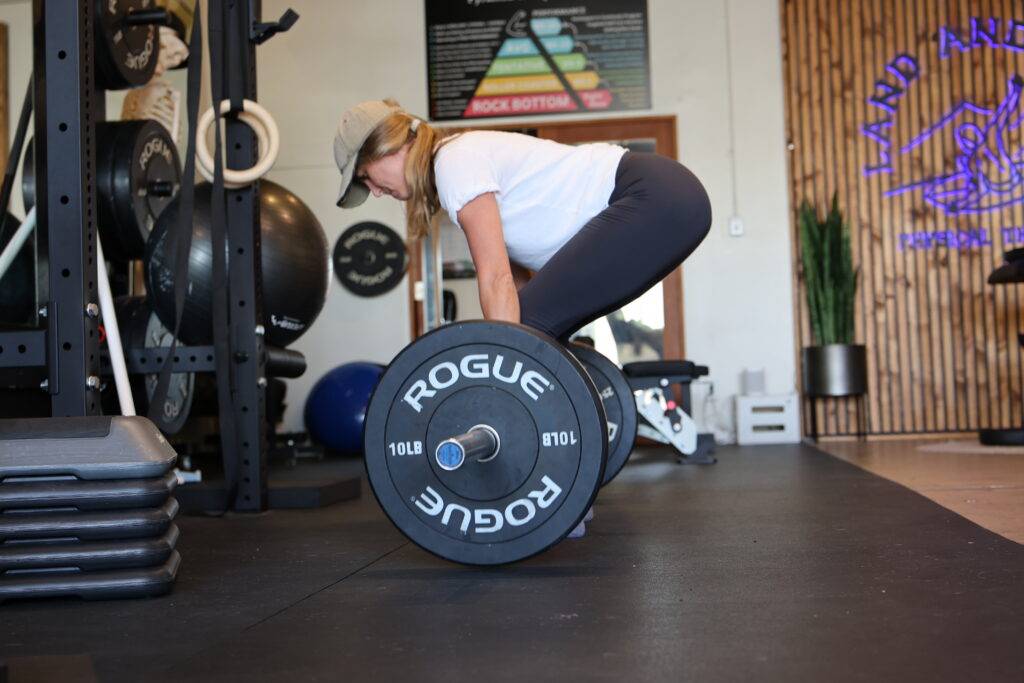
Activities that place the hamstring under both load and stretch are common triggers. These include uphill running, sprinting, deep squats, lunges, and Romanian deadlifts. When tissue capacity has been exceeded, these movements increase the demand on the proximal tendon and often provoke symptoms.
Sitting can also be surprisingly irritating because it compresses the tendon against the ischial tuberosity. That’s why desk work, long drives, and air travel frequently trigger flare-ups.
Stretching deserves special attention. End-range hamstring stretching places substantial tensile load on the tendon and is one of the most reliable ways to make symptoms worse. If you’ve been stretching and foam rolling consistently without improvement, this may be why.
How This Condition Develops
Most cases develop after a period of doing too much, too soon. A sudden increase in running mileage, adding hill sprints or speed work, starting a heavy strength program with hip-hinge exercises, or dramatically increasing yoga and stretching are all common examples.
In each case, the tendon receives more load than it can recover from between sessions. Over time, the cumulative stress exceeds the tissue’s ability to adapt, and activities that were once well tolerated begin to provoke symptoms.
Why Rest Alone Doesn’t Fix It
Tendons need both load and recovery to stay healthy.
While a short period of symptom reduction can be helpful, complete rest removes the stimulus that drives adaptation. The tendon may feel better temporarily, but it often remains weak and sensitive. When normal activity resumes, symptoms frequently return.
This boom-and-bust cycle is common in people with chronic proximal hamstring tendinopathy. They rest until symptoms calm down, return to activity, flare up again, and repeat the process.
The way out is progressive loading. The goal is to expose the tendon to an appropriate amount of stress, allow it to adapt, and gradually increase that stress over time.
What Rehab Looks Like
Early rehabilitation focuses on reducing the most aggravating loads while introducing exercises the tendon can tolerate. Isometric hamstring exercises in relatively shortened positions are often a good starting point because they place tension through the tendon without excessive stretch or compression.
As symptoms improve, the program gradually progresses. More hip-flexion range is introduced, followed by heavier loading and eventually more dynamic movements. The final stage involves returning to the specific activities that triggered the problem in the first place.
Imaging is rarely necessary in the early stages. Tendon changes commonly appear on MRI scans, even in people without pain, and those findings rarely change the initial treatment plan.
A Simple Sitting Modification
One practical strategy that often helps is to place a small cushion or rolled towel under the thigh rather than directly under the sit bone. This reduces some of the compression placed on the tendon attachment while sitting.
While it won’t solve the underlying problem, it can make work, travel, and daily activities more comfortable as you progress through rehabilitation. Combined with a well-designed loading program, simple modifications like this can make recovery much more manageable.
If you’d like to learn more or schedule an appointment, visit our business profile page.

Dr. Jonny Blue is a Doctor of Physical Therapy and founder of Land and Sea Physical Therapy in Oceanside, CA. He specializes in orthopedic PT, root cause methodology, and helping active adults in North County San Diego get back to the activities they love without surgery or pain medication.