
One of the most counterproductive things you can do with knee pain is stop loading the knee entirely. It feels like the safest option: rest it, avoid anything that hurts, and wait for it to heal. But patellofemoral pain doesn’t usually improve with complete avoidance. In many cases, removing all load actually reduces the knee’s capacity over time, making it more sensitive when you eventually return to activity.
Effective patellofemoral pain treatment is built on a different idea. Stress is not the problem. The issue is the dose of stress applied to the joint.
Understanding Stress as a Continuum
Every exercise places some level of stress on the patellofemoral joint, and that stress changes based on how the movement is performed. More knee bend generally increases joint stress, heavier loads increase it further, and deeper positions tend to raise it as well. None of these factors are inherently harmful; they are simply variables that can be adjusted based on your current tolerance.
Think of this as a continuum. On one end are low-demand movements like a hip hinge or shallow squat. On the other end are high-demand movements such as deep, loaded, heel-elevated squats. The higher end isn’t “bad”; it may be ideal for someone with a well-conditioned knee. It is simply not the right starting point for someone currently in a flare-up.
The goal is to identify where you are on that continuum, begin there, and gradually progress as your tolerance improves. This same principle applies to daily activities. If running is the goal but stairs already provoke pain, running is not automatically off-limits. It just means you need a more appropriate starting point, such as walking, and a structured progression from there.
Volume and Frequency Matter as Much as Exercise Choice
One of the most overlooked aspects of patellofemoral pain is that stress is cumulative. It doesn’t come only from a single exercise, but from the total load accumulated across the day and week. A short run may be well tolerated, but that doesn’t mean a sudden increase in mileage or activity will be tolerated in the same way.
This is why rapid spikes in activity are such a common trigger for symptoms. Starting a new running program, significantly increasing step count, or adding a lot of stair climbing in a short period can exceed the knee’s current capacity. The issue is not the activity itself, but the speed at which the load increases.
The solution is not avoidance. It is a controlled progression that allows the tissue time to adapt to increasing demand.
What This Means for Your Rehab
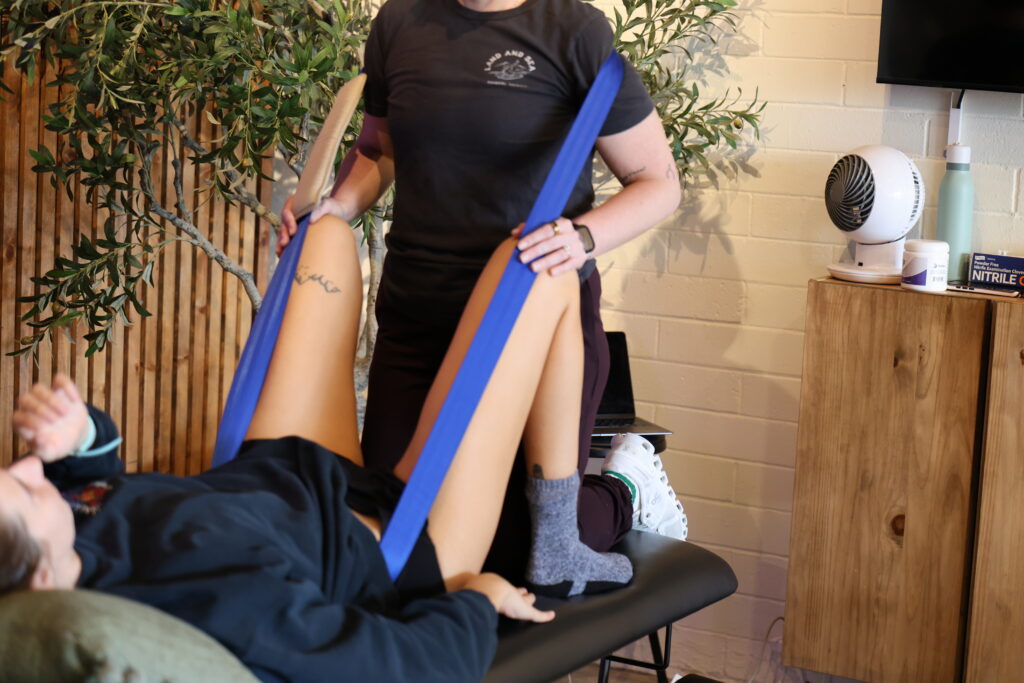
Patellofemoral pain treatment should not focus on what you cannot do. Instead, it should be a structured program that meets you where you are and gradually builds capacity over time. Hip strengthening, quad strengthening, and progressive knee-loading exercises are the main tools used to achieve this.
The key is choosing the right starting point and progressing at a pace the knee can tolerate. Pain during exercise does not automatically mean damage, especially if symptoms settle afterward and function is gradually improving over time.
The goal is not to find a single pain-free exercise and avoid everything else. The goal is to keep loading the system appropriately so the knee becomes stronger, more tolerant, and more resilient over time.
If you want to contact us or book an appointment, check our business profile page.

Dr. Jonny Blue is a Doctor of Physical Therapy and founder of Land and Sea Physical Therapy in Oceanside, CA. He specializes in orthopedic PT, root cause methodology, and helping active adults in North County San Diego get back to the activities they love without surgery or pain medication.