Written by: Dr. Jonny Blue, DPT
If you’ve been dealing with golfer’s elbow or tennis elbow, you’ve probably already tried the obvious stuff- rest, ice, a brace, maybe some forearm stretches. And it probably helped a little. Until you picked up a golf club, grabbed a barbell, or spent a weekend doing yard work. Then it came right back.
Here’s what most people (and honestly, most providers) miss about elbow pain.
Your elbow pain usually probably isn’t an elbow problem.
Golfer’s elbow (medial epicondylitis) and tennis elbow (lateral epicondylitis) are both commonly blamed on overuse of the forearm muscles. And technically, that’s true, the forearm muscles are overloaded. But the real question is why they’re overloaded.
It’s not because you’re playing too much tennis. It’s not because you’re gripping too hard at the gym. The research, and what we see consistently in the clinic, points to one primary culprit: the mid-back isn’t doing its job.
The chain that nobody talks about
Your shoulder, scapula, mid-back, and core all work together to support any gripping or pulling movement. When the mid-back muscles are weak or inhibited, the load gets redistributed down the chain, and your forearm muscles end up absorbing stress they were never designed to handle. Do that repeatedly over weeks and months, and you get the classic tendinopathy pattern: pain with gripping, stiffness in the morning, flare-ups that seem random but aren’t.
In the clinic, we see this pattern constantly. Patient comes in with pain on one side of the elbow. There’s always tightness in the opposing muscle group and weakness in the mid-back. Every time.
What actually fixes it
Treating elbow pain correctly means addressing three things simultaneously:
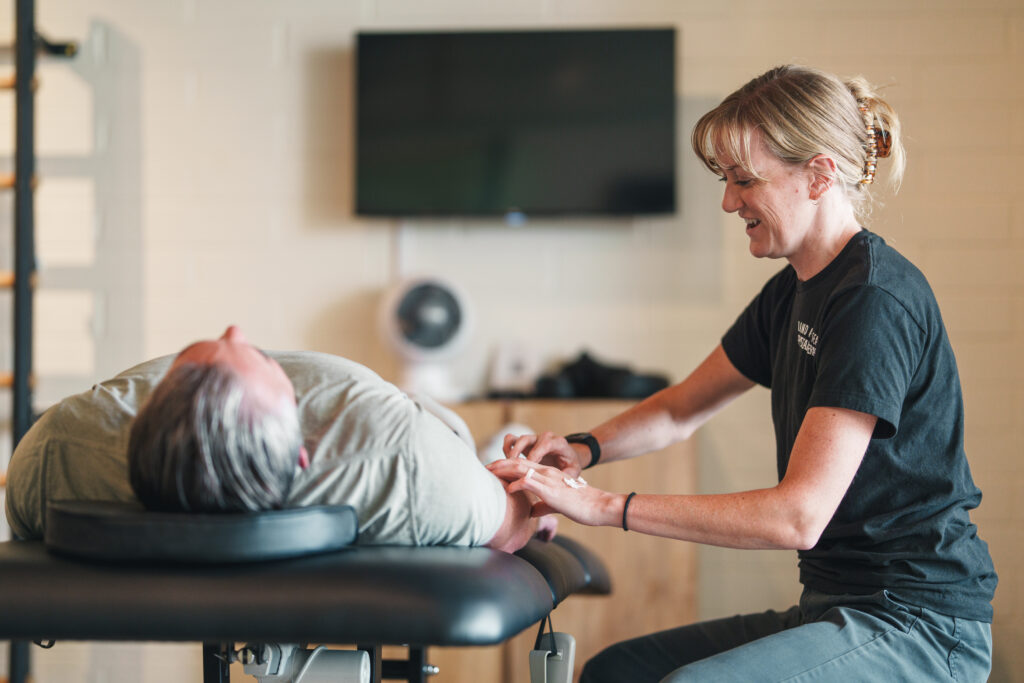
First, you calm down the overactive tissue at the elbow itself — reducing pain and restoring normal movement patterns so the joint can function without guarding.
Second, you restore mobility to the tight muscles on the opposing side of the elbow. Tight muscles pulling against an already irritated tendon is a recipe for a pain cycle that never ends.
Third, and this is the part most people skip, you build real strength in the muscles that are supposed to be doing the work. That means the mid-back (rows, band pull-aparts, Y/T raises on a stability ball), the scapular stabilizers (wall slides, prone I-T-Ws), and the core (bird dogs and side planks to stabilize the entire upper chain).
When those muscles are strong and doing their job, the forearm muscles can finally relax. The grip stays strong without the elbow taking the hit.
Why don’t professional athletes don’t get tennis elbow?
This is the question worth asking. Professional tennis players and golfers use their arms far more than you do, and they rarely develop chronic epicondylitis. The difference isn’t technique alone. It’s that their posterior chain, scapular stabilizers, and rotator cuff musculature are trained to absorb and distribute load efficiently. The elbow never becomes the weak link because everything upstream is doing its job.
That’s the standard we work toward for every patient. It’s not just about getting you out of pain, but building the foundation that keeps it from coming back.
When to take this seriously
If your elbow flares up after gripping-heavy activities — golf, climbing, weightlifting, racket sports, even yard work — and it keeps coming back no matter how much you rest it, that’s your signal that rest isn’t the solution. The underlying weakness is still there. It’ll keep loading the elbow until you address it directly.
What to do next
At Land and Sea Physical Therapy, we assess the full chain — elbow, wrist, shoulder, mid-back, and core — to find exactly what’s driving your pain. Then we build a plan that treats the source, not just the symptom.
If you’ve been dealing with elbow pain that won’t quit, book a discovery call and let’s figure out what’s actually going on.

Dr. Jonny Blue is a Doctor of Physical Therapy and founder of Land and Sea Physical Therapy in Oceanside, CA. He specializes in orthopedic PT, root cause methodology, and helping active adults in North County San Diego get back to the activities they love without surgery or pain medication.