
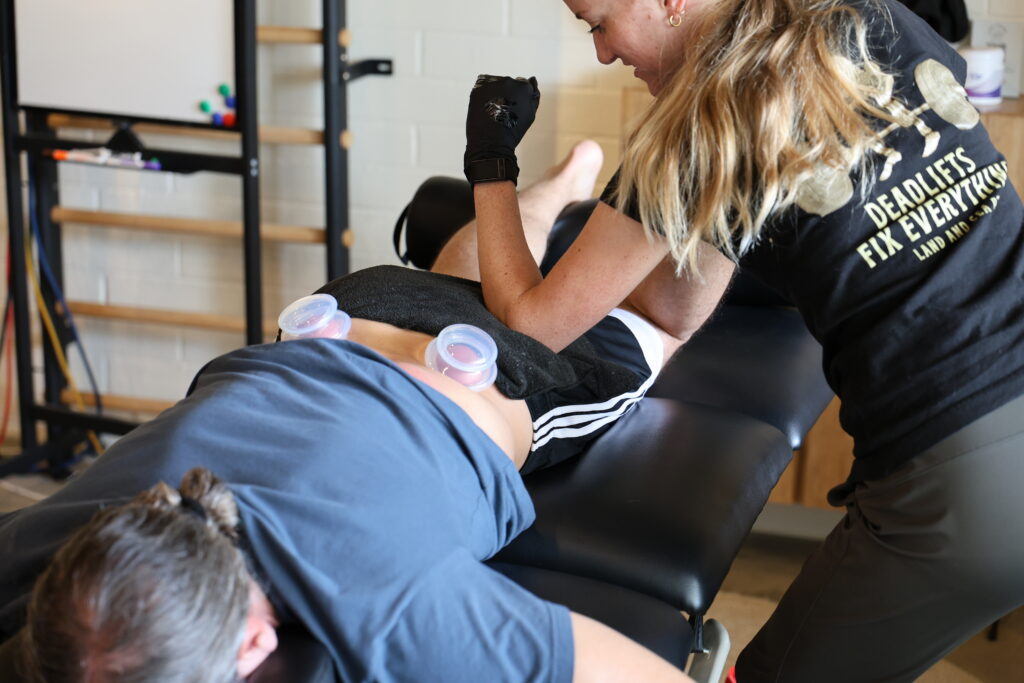
Stretching more, resting more, and waiting for the pain to go away is a common approach people take when dealing with proximal hamstring tendinopathy. Unfortunately, this strategy often does not address the actual problem. The missing piece is usually progressive loading: gradually rebuilding the tendon’s ability to tolerate stress and return to normal activity.
Where the Pain Comes From
The hamstrings are made up of three muscles: the semimembranosus, semitendinosus, and the long head of the biceps femoris. These muscles all attach to the ischial tuberosity, which most people know as the sit bone. In proximal hamstring tendinopathy, the tendon where these muscles attach becomes irritated and painful.
The discomfort is typically felt deep in the lower glute region near the sit bone. It may occasionally travel partway down the back of the thigh, but pain at the attachment point is one of the defining features of this condition. Symptoms that worsen with sitting or loaded hip movements are common signs of proximal hamstring tendinopathy.
Activities That Load the Tendon
Understanding what aggravates the tendon helps explain why certain treatment approaches are more effective than others. Activities that place the hamstring under both stretch and load are common triggers, including uphill running, sprinting, deep squats, lunges, and Romanian deadlifts.
Sitting for long periods can also increase symptoms because it compresses the tendon against the sit bone. This is why long car rides, desk work, and extended periods of sitting often lead to flare-ups.
Stretching may seem like the obvious solution, but aggressive hamstring stretching at end range can place significant stress on an already irritated tendon. For many people with proximal hamstring tendinopathy, repeated stretching and foam rolling can actually prolong symptoms rather than improve them.
How This Condition Develops
Proximal hamstring tendinopathy often develops when the tendon is exposed to more stress than it is currently prepared to handle. This can happen after a sudden increase in running volume, adding hill sprints or speed work too quickly, starting a new exercise program, or increasing activities that involve deep hip hinging.
The problem is usually not one single event. Instead, the tendon’s workload gradually exceeds its ability to recover and adapt. Over time, activities that once felt normal may start causing pain because the tendon’s overall tolerance has decreased.
Why Rest Alone Does Not Fix It
Tendons become stronger by adapting to load. Complete rest may reduce symptoms temporarily, but it does not rebuild the tendon’s capacity to handle stress.
When normal activity resumes, the same demands return and symptoms often come back. This creates a frustrating cycle where pain leads to rest, rest reduces symptoms, and returning to activity brings the pain back again.
The solution is not avoiding load forever. It is gradually introducing the right amount of stress through a structured strengthening program that allows the tendon to adapt.
What Rehab Looks Like
Early rehabilitation focuses on reducing the activities that are most irritating while still providing the tendon with appropriate loading. This often begins with exercises that create tension without excessive stretching or compression. Isometric hamstring exercises, especially in a shortened position, are commonly well tolerated during the early stages.
As the tendon becomes stronger, rehabilitation progresses by gradually increasing range of motion, resistance, and movement demands. Eventually, the goal is to return to the activities that caused the problem in the first place, whether that is running, lifting, or sports.
Imaging is not always necessary because tendon changes can appear on MRI even in people who have no pain. Treatment decisions should be based on symptoms, movement patterns, and function rather than imaging findings alone.
A Simple Sitting Modification That Can Help
One practical way to reduce irritation while working through rehab is modifying how you sit for longer periods. Using a small cushion or rolled towel under the back of your thigh instead of directly under the sit bone can reduce pressure on the proximal hamstring tendon.
This does not address the underlying cause of the problem, but it can make daily activities more comfortable while the tendon rebuilds its capacity. Managing aggravating activities while progressively strengthening the tendon is the foundation of successful proximal hamstring tendinopathy rehabilitation.
If you want to contact us or book an appointment, check our business profile page.

Dr. Jonny Blue is a Doctor of Physical Therapy and founder of Land and Sea Physical Therapy in Oceanside, CA. He specializes in orthopedic PT, root cause methodology, and helping active adults in North County San Diego get back to the activities they love without surgery or pain medication.