
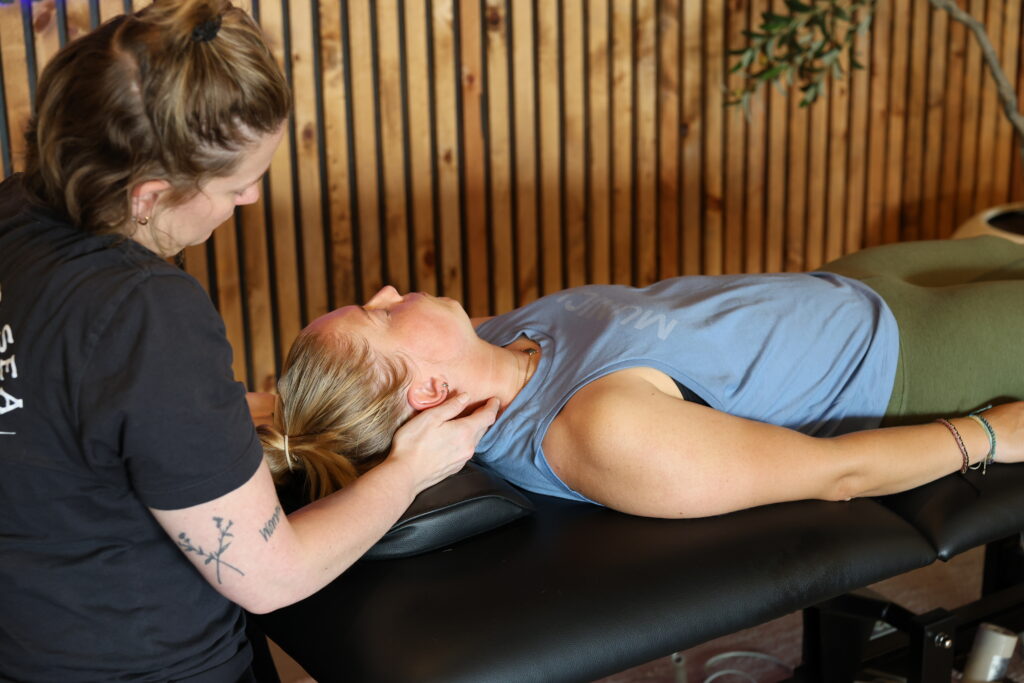
A pinched nerve in the neck, or cervical radiculopathy, isn’t actually a nerve being squeezed like a garden hose. The process is much more complex, and understanding what’s really happening can completely change how you approach recovery.
Your cervical spine contains seven vertebrae with soft discs between each bone. Your spinal cord runs through this area, and nerves branch off to provide strength and sensation to your shoulders, arms, and hands. A disc herniation or the gradual changes that occur with aging can irritate one of these nerves. When that happens, people often develop what is commonly called a pinched nerve.
What Neurological Changes Actually Mean
The phrase “neurological changes” sounds intimidating, but it simply describes how a nerve behaves when it becomes irritated.
You may notice numbness, tingling, burning, or pain that travels from your neck into your arm or hand. Some people also develop weakness in their shoulder, arm, or grip. Pain isn’t always felt in the neck, either. It can appear between the shoulder blades or farther down the arm, which is why many people don’t immediately realize their neck is the source.
The location of your symptoms often depends on which nerve is affected, but not always. Human bodies don’t always follow textbook patterns.
It’s also important to understand that symptoms exist on a spectrum. Two people can have nearly identical MRI findings, yet one has significant weakness while the other has no symptoms at all. Imaging is only one piece of the puzzle, and it rarely tells the whole story.
Why Imaging Doesn’t Tell the Whole Story
This is where many people become unnecessarily worried. They receive an MRI report with terms like “disc herniation,” “stenosis,” or “degeneration” and assume something is seriously damaged.
In reality, these findings are extremely common, even in people who have no neck pain or arm symptoms. An MRI can identify structural changes, but those changes don’t automatically explain why you’re hurting. They also don’t predict whether your condition will get worse.
Your physical exam, medical history, and symptom pattern often provide more useful information than imaging alone. That’s why healthcare providers treat people, not MRI reports.
How Neck Movement Affects Symptoms
Your neck moves in several directions, including looking up and down, turning side to side, and bending toward each shoulder. It also moves forward into protraction, like when you’re leaning toward your phone or computer, and backward into retraction, when you pull your head back.
Every movement requires your joints, muscles, discs, and nerves to work together. Understanding how your neck moves helps explain why certain positions or activities aggravate your symptoms while others provide relief.
The Good News Most Patients Never Hear
One of the most reassuring things about cervical radiculopathy is that it usually has a favorable recovery. Many people improve over time without surgery.
Research comparing surgery with physical therapy and other conservative treatments shows similar long-term outcomes. For most people, non-operative treatment should be the first step unless they have significant or progressive neurological weakness.
That doesn’t mean you simply wait for the problem to resolve. Treatment focuses on reducing pain, restoring normal movement, rebuilding strength, and helping you return to the activities that matter most. Instead of trying to change what your MRI looks like, rehabilitation focuses on improving how your body functions.
When you understand what’s actually happening, the diagnosis becomes much less frightening. A pinched nerve doesn’t automatically mean surgery, permanent damage, or lifelong pain. With the right treatment plan, realistic expectations, and a gradual return to activity, most people recover very well.
If you want to contact us or book an appointment, check our business profile page.

Dr. Jonny Blue is a Doctor of Physical Therapy and founder of Land and Sea Physical Therapy in Oceanside, CA. He specializes in orthopedic PT, root cause methodology, and helping active adults in North County San Diego get back to the activities they love without surgery or pain medication.